


Last week I had a fruitful discussion with a fellow blogger on the web, Martin Sauter (@mobilesociety) regarding a post in which he compared features of LTE RRC (3GPP 36.331) and NR RRC (3GPP 38.331).
It was Martin's impression that the NR RRC protocol is primarily designed to be used in the 5G standalone mode. However, as I wrote in a comment to his post the NR RRC protocol is already used in EN-DC radio connections.
The reason is that the UE must be informed about Hundreds of lower layer 5G parameters (physical, MAC, RLC) that are needed for the payload transmission over 5G frequencies. Indeed, when it comes to user plane data transmission the gNB works almost independently and the UE must handle LTE and NR radio links in parallel.So it has two different radio units (even if combined into a single radio chip set). This double-functionality is also one important reason why 5G smartphones are quite expensive. It is a lot of software and know-how that sits inside these chips.
How much surplus code is really necessary to enable 5G technology becomes visible when looking at trace data using a state-of-the-art protocol test and monitoring tool.
When reading the 3GPP 36.331 (LTE RRC) standard document one might have the impression that just a few 5G parameters have been incorporated into this protocol to support EN-DC connections.
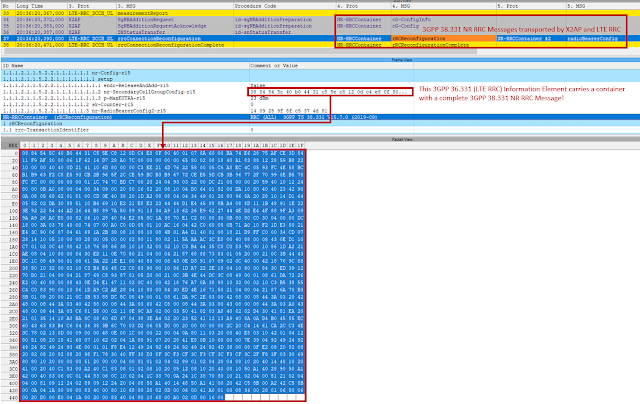
However, when looking into the details of e.g. the nr-SecondaryCellGroupConfig-r15 it turns out that some this single information element is indeed a huge block of NR information (total size: 1111 Byte)
It is an entire 5G RRC message (rRCReconfiguration) that is piggybacked by the LTE rrcConnectionReconfiguration message, because in 5G non-standalone mode this is the only way to transmit 5G signaling information to the UE. And as highlighted in the upper part of the screenshot there are a couple of NR RRC messages transported in so-called NR-RRCContainers* during the EN-DC Establishment Procedure.
And what about 5G standalone mode? For this radio access technology the 3GPP 38.331 Rel. 15 protocol is suitable as well. Hence, some parameters mentioned in the standard paper will never be seen in EN-DC. A perfect example is S-NSSAI (Single Network Slice Selection Assistance Information), because network slicing requires the connection with a 5G core network as a prerequisite.
* This is not an 3GPP term, but coined by the developers of the decoding engine.
It was Martin's impression that the NR RRC protocol is primarily designed to be used in the 5G standalone mode. However, as I wrote in a comment to his post the NR RRC protocol is already used in EN-DC radio connections.
The reason is that the UE must be informed about Hundreds of lower layer 5G parameters (physical, MAC, RLC) that are needed for the payload transmission over 5G frequencies. Indeed, when it comes to user plane data transmission the gNB works almost independently and the UE must handle LTE and NR radio links in parallel.So it has two different radio units (even if combined into a single radio chip set). This double-functionality is also one important reason why 5G smartphones are quite expensive. It is a lot of software and know-how that sits inside these chips.
How much surplus code is really necessary to enable 5G technology becomes visible when looking at trace data using a state-of-the-art protocol test and monitoring tool.
When reading the 3GPP 36.331 (LTE RRC) standard document one might have the impression that just a few 5G parameters have been incorporated into this protocol to support EN-DC connections.
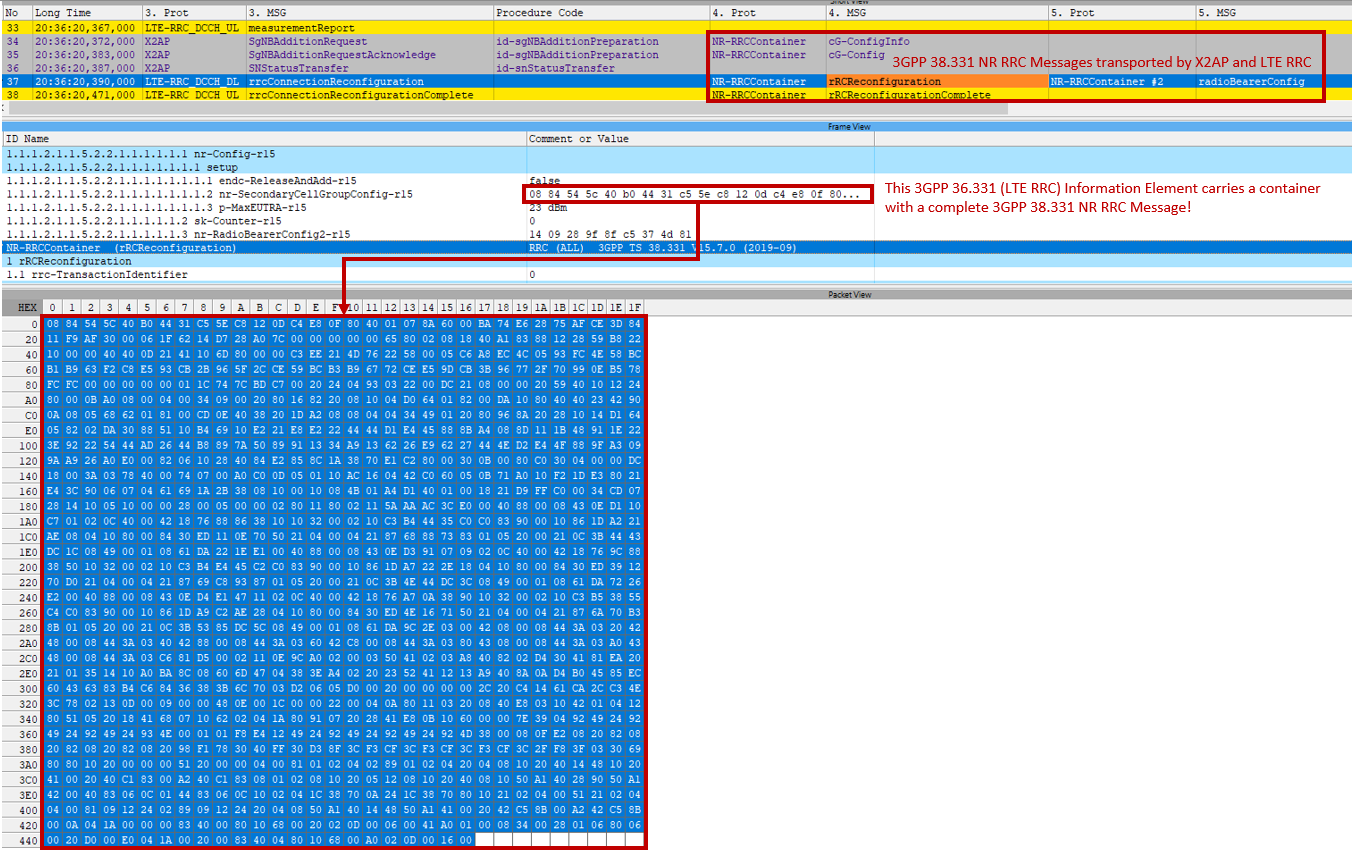
However, when looking into the details of e.g. the nr-SecondaryCellGroupConfig-r15 it turns out that some this single information element is indeed a huge block of NR information (total size: 1111 Byte)
It is an entire 5G RRC message (rRCReconfiguration) that is piggybacked by the LTE rrcConnectionReconfiguration message, because in 5G non-standalone mode this is the only way to transmit 5G signaling information to the UE. And as highlighted in the upper part of the screenshot there are a couple of NR RRC messages transported in so-called NR-RRCContainers* during the EN-DC Establishment Procedure.
And what about 5G standalone mode? For this radio access technology the 3GPP 38.331 Rel. 15 protocol is suitable as well. Hence, some parameters mentioned in the standard paper will never be seen in EN-DC. A perfect example is S-NSSAI (Single Network Slice Selection Assistance Information), because network slicing requires the connection with a 5G core network as a prerequisite.
(click on image for larger version)
* This is not an 3GPP term, but coined by the developers of the decoding engine.


