Pages

Subscribe:
Showing posts with label 4G. Show all posts

How LTE RRC (4G) and NR RRC (5G) Protocols are used in Parallel in EN-DC (5G NSA)

Last week I had a fruitful discussion with a fellow blogger on the web, Martin Sauter (@mobilesociety) regarding a post in which he compared features of LTE RRC (3GPP 36.331) and NR RRC (3GPP 38.331).

It was Martin's impression that the NR RRC protocol is primarily designed to be used in the 5G standalone mode. However, as I wrote in a comment to his post the NR RRC protocol is already used in EN-DC radio connections.

The reason is that the UE must be informed about Hundreds of lower layer 5G parameters (physical, MAC, RLC) that are needed for the payload transmission over 5G frequencies. Indeed, when it comes to user plane data transmission the gNB works almost independently and the UE must handle LTE and NR radio links in parallel.So it has two different radio units (even if combined into a single radio chip set). This double-functionality is also one important reason why 5G smartphones are quite expensive. It is a lot of software and know-how that sits inside these chips.

How much surplus code is really necessary to enable 5G technology becomes visible when looking at trace data using a state-of-the-art protocol test and monitoring tool.

When reading the 3GPP 36.331 (LTE RRC) standard document one might have the impression that just a few 5G parameters have been incorporated into this protocol to support EN-DC connections.

However, when looking into the details of e.g. the nr-SecondaryCellGroupConfig-r15 it turns out that some this single information element is indeed a huge block of NR information (total size: 1111 Byte)

It is an entire 5G RRC message (rRCReconfiguration) that is piggybacked by the LTE rrcConnectionReconfiguration message, because in 5G non-standalone mode this is the only way to transmit 5G signaling information to the UE. And as highlighted in the upper part of the screenshot there are a couple of NR RRC messages transported in so-called NR-RRCContainers* during the EN-DC Establishment Procedure.

And what about 5G standalone mode? For this radio access technology the 3GPP 38.331 Rel. 15 protocol is suitable as well. Hence, some parameters mentioned in the standard paper will never be seen in EN-DC. A perfect example is S-NSSAI (Single Network Slice Selection Assistance Information), because network slicing requires the connection with a 5G core network as a prerequisite. 
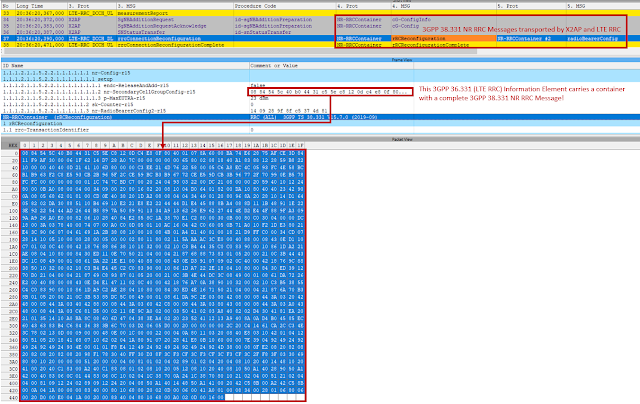

(click on image for larger version)

* This is not an 3GPP term, but coined by the developers of the decoding engine.

EPS Fallback in 5G Standalone Deployments

It can be expected that later this year some mobile network operators will launch their initial 5G standalone (5G SA) deployments.

Nevertheless there will remain areas with temporary or permanently weak 5G NR coverage. One possible reason might be that even when 5G and LTE antennas are co-located, which means: mounted at the same remote radio head, the footprint of the 5G NR cell is significantly smaller when it uses a higher frequency band than LTE - see figure 1.

Figure 1: Smaller footprint of co-located 5G NR cell with higher frequency
Especially UEs making Voice over New Radio (VoNR) calls from the 5G cell edge have a high risk of experiencing bad call quality, in worst case a call drop. To prevent this the UE is forced  during the voice call setup towards 5G core network (5GC) to switch to a LTE/EPS connection where the radio conditions are better for the voice service.

The same procedure for which the term "EPS Fallback" was coined by 3GPP also applies when the UE is served by a 5G cell that is not configured/not optimized for VoNR calls or when the UE does not have all needed VoNR capabilities.

Figure 2: Two options for EPS fallback

When looking at the RAN there are two options for executing the EPS Fallback as shown in figure 2.

In option A the 5G radio connection is released after the initial call attempt is successfully finished and with the 5G RRC Release the UE is ordered to reselect to a 4G cell where a new radio connection is started for the VoLTE call. In this case the UE context is transferred from the AMF to the MME over the N26 interface. 3GPP seems to use also the term "RAT fallback" for this option.

Option B is to perform a 5G-4G inter-RAT handover. Here the session management and user plane tunnels in the core network are handed over from SMF/UPF to MME/S-GW in addition. This is realized with the GTPv2 Forward Relocation procedure on N26 interface.

All in all the EPS fallback is expected to cause an additional call setup delay of approximately 2 seconds.

For the inter-RAT handover case it is easy to detect from signaling information that an EPS fallback was triggered. In the source-eNodeB-to-target-eNodeB-transparent-container sent by the gNB to the eNB a boolean "IMS voice EPS fallback from 5G" indicator will be found that is set to "true". This container is named according to the receiving entity and will be carried by the NGAP Handover Preparation, GTPv2 Forward Relocation Request and the S1AP Handover Request messages.

If a redirection for Voice EPS Fallback is possible or not is indicated in the NGAP Initial Context Setup Request, Handover Request (during 5G intra-system handover) and Path Switch Request Acknowledge (after Xn handover) messages, all sent by the AMF to the gNB.

Further the NGAP protocol provides the cause value "IMS voice EPS fallback or RAT fallback triggered" in the PDU Session Resource Modify Response message indicating that a requested VoNR session cannot be established.  


NTT Docomo's Vision on 5G Evolution and 6G


NTT Docomo released a whitepaper on 5G Evolution and 6G. In a press release they announced:

NTT DOCOMO has released a white paper on the topic of 6G, the sixth-generation mobile communications system that the company aims to launch on a commercial basis by 2030. It incorporates DOCOMO's views in the field of 5G evolution and 6G communications technology, areas that the company has been researching since 2018. The white paper summarizes the related technical concepts and the expected diverse use cases of evolving 5G and new 6G communication technologies, as well as the technology components and performance targets.

Mobile communication systems typically evolve into the next generation over a period of roughly ten years; DOCOMO commenced its research into the commercial launch of 5G in 2010. In 2018, the company conducted successful radio wave propagation experiments at frequencies of up to 150 GHz, levels which are expected to enable the much faster and larger-capacity communications that 6G will require.

DOCOMO will continue to enhance the ultra-high-speed, large-capacity, ultra-reliable, low-latency and massive device-connectivity capabilities of 5G technology. It will continue its research into and development of 5G evolution and 6G technology, aiming to realize technological advances including:

  • the achievement of a combination of advances in connectivity, including ultra-high speed, large capacity and low latency
  • the pioneering of new frequency bands, including terahertz frequencies
  • the expansion of communication coverage in the sky, at sea and in space
  • the provision of ultra-low-energy and ultra-low-cost communications
  • the ensuring of highly reliable communications
  • the capability of massive device-connectivity and sensing

Visitors to DOCOMO Open House 2020 will be able to view conceptual displays incorporating DOCOMO's vision of the evolution of 5G technologies into 6G. The event will take place in the Tokyo Big Sight exhibition complex in Tokyo on January 23 and 24. DOCOMO also plans to hold a panel session entitled "5G Evolution and 6G" on January 24.

Videos from Docomo Open House are embedded below, along with a previous talk by Takehiro Nakamura from 6G Summit.


6G has become a hot topic, especially after China announced back in November that they are working on 6G. We have some interesting tweets on 6G as well.

This one from Stefan Pongratz, Dell'Oro group shows the timeline for 5G, Pre-6G and 6G


This one provides a timeline all the way from Release 99 up till 21


Finally, here is a tweet highlighting the 6G research


Finally, the paper acknowledges the 5G challenges and focus areas for 5G evolution, before focusing on 6G.
The mmWave coverage and mobility needs improvement, while the downlink is able to provide very high data rates, the uplink is struggling to be better than 4G. Also, there are some very extreme requirements for industrial use cases, 5G has yet to prove that it can meet them.

Finally, here is another view from iDate Digiworld comparing 5G vs 6G in terms of performance, spectrum and network.


Related Posts:

How MOCN RAN-Sharing Works


Shared RAN deployment scenarios are an excellent opportunity for mobile network operators to lower their investments on both, network hardware and operational costs by sharing resources.

The MORAN approach where each operator continues to have its dedicated spectrum (= radio network cells) is easy to understand.

However, the Multi-Operator Core Network (MOCN) is a bit more complex, especially if one of the involved operators asks for service assurance KPIs that apply to its - and only its - subscribers. In this case it is a prerequisite to find out which "call" belongs to which core network operator to enable further KPI correlation and aggregation.

The figure below illustrates how this works:

(click on picture for larger version)

In the System Information Block (SIB) 1 of the cell a list of PLMN-IDs is broadcasted followed by a single Tracking Area Code (which can be combined each of the PLMN-IDs to get multiple TAIs) and a single Cell Identity.

Encoding is specified in 3GPP 36.331 (RRC) as follows:

SystemInformationBlockType1 ::=     SEQUENCE {
    cellAccessRelatedInfo              SEQUENCE {
       plmn-IdentityList                 PLMN-IdentityList,
       trackingAreaCode                  TrackingAreaCode,
       cellIdentity                      CellIdentity,

The spec further defines that the ECGI is the CellIdentiy combined with the first (!!!) PLMN-ID from the PLMN-ID List:

CellGlobalIdEUTRA field descriptions
cellIdentity
Identity of the cell within the context of the PLMN.
plmn-Identity
Identifies the PLMN of the cell as given by the first PLMN entry in the plmn-IdentityList in SystemInformationBlockType1.

So there is one and only 1 ECGI per radio cell in the network, but multiple PLMN-IDs and hence, multiple TAI, one fore each core network operator, are broadcasted.

During RRC establishement a particular UE signals on behalf on the selected PLMN-ID information element in the RRC Connection Setup Complete message to which core network operator shall be used.

This information is "translated" by the eNB into ECGI and TAI with different PLMN-IDs. While the ECGI displays the PLMN-ID of the operator that owns the RAN equipment the TAI shows the selected PLMN-ID of the UE's core network operator. 

Guest Post: Exploring Network Convergence of Mobile, Broadband and Wi-Fi

This is a guest post by Ben Toner, Founder and Director, Numerous Networks


Are multiple networks better than one?

How many articles have you read with a title similar to "Which technology is better, 5G or Wi-Fi6?" If, like me, you regularly use Wi-Fi and cellular (I still use 4G though) then you might find it hard to take sides.

Enter Network Convergence - the concept of bringing multiple networks together to get the best of them all. Imagine, as an end user, not having to decide which network to use but instead feeling satisfied that your data was traversing the best combination of networks at that moment in time.

Imagine a business traveler being connected to Wi-Fi which is slow or busy while trying to take that all important conference call while sitting in an airport. Because you are roaming you want to use that Wi-Fi but you do not want to compromise the video call quality. If your network and device could work together to use just enough cellular data to supplement the slow Wi-Fi so that you stayed within your daily roaming quota but never lost a moment in the video call - then you would probably be very happy with that service. Better still, as you start walking off, if the call transitioned from Wi-Fi to cellular with no dropouts or hangup then you might be delighted!

Earlier I underlined best because that in itself is somewhat complicated.  The example above is easy to desribe but quite hard for to achieve within a framework where all possible scenarios are handled that well, for every user. The common questions which need to be factored into any such choice are:
  • What do I as the end user want? 
  • What performance can each network deliver. 
  • How important is the transfer of content at that time and 
  • How much am I willing to pay for it (how many MB of my data plan am I willing to use?). 

This is one of the challenges that we cannot easily solve today, but technology is being developed to help in that process. The operators and device vendors are working within standardisation to develop technology which can provide such a converged service. However at this time there is still a rules mechanism behind it all which does not really describe how user input and preference is going to be captured.

In the last 10 years I have witnessed many battles within service providers when deciding what "one size fits all" service to offer everyone when deciding how to make service provider Wi-Fi available to their customers; all fuelled by my points above.

A lot of concepts are well designed and somewhat mature but deciding exactly what will be implemented in standards is currently ongoing.

In the following slides and video I introduce this whole concept of Network Convergence. The following content introduces the concept and then takes a detailed look at the ATSSS; technology being defined in 3GPP. I also have highlighted the technologoies you can get hold of today to try out network convergence.

I encourage you all to download the example technologies and try convergence for yourself. I'm eager to hear opinions of what technologies work best for each of you. And better still, what is not being provided which you think should be...

Looking forward to your feedback and answering your questions...


Ben Toner
Founder and Director, Numerous Networks


Related Posts:

Private 4G / 5G Cellular Networks and Bring Your Own Spectrum


With 4G maturing, private cellular networks are finally getting the attention that they deserve and has been promised for quite a while. In a Industry Analyst event, Nokia announced that they are running 120+ private networks including transportation, Energy, Public sector, Smart cities, manufacturing and logistics, etc. (tweet below). The Enterprise Business division is now accounting for 5% of the revenue.
Ray Le Maistre, Editor-in-Chief at Light Reading, in an opinion on Telecoms.com pointed out:

One of the more immediate revenue stream opportunities right now is wireless private networks, and the good news is that this opportunity doesn’t require 5G. Instead, the potential looks set to be enhanced by the availability of a full set of 5G standards (including the yet-to-be concluded core network specs) and the maturity of associated technology.

In the meantime, 4G/LTE has already been the cellular foundation for an increasingly thriving wireless private networks sector that, according to ABI Research, will be worth $16.3 billion by 2025

Another market sizing prediction, this time by SNS Telecom & IT, pitches annual spending on private 4G and 5G networks at $4.7 billion by the end of 2020 and almost $8 billion by 2023. 

However this plays out, there’s clear anticipation of growing investment. What’s particularly interesting, though, is which organizations might pocket that investment. That’s because enterprises and/or organizations looking to benefit from having a private wireless network have a number of options once they decide to move ahead with a private network – here are three permutations that look most likely to me:
  1. Build and run it themselves – technology vendors get some sales in this instance
  2. Outsource the network planning, construction and possibly even the day-to-day. management of the network to a systems integrator (SI) – the SI and some vendors get the spoils. It’s possible here, of course, that the SI could be a technology vendor.
  3. Outsource to a mobile network operator – the operator and some vendors will get some greenbacks.
For sure there will be other permutations, but it shows how many different parts of the ecosystem have some skin in the game, which is what makes this sector so interesting.

What’s also interesting, of course, is what the enterprises do with their private networks: Does it enhance operations? Help reduce costs? Create new business opportunities? All of the above?

Let’s not forget the role of the regulators in all of this. In the US the private wireless sector has been given a shot in the arm by the availability of CBRS (Citizens Broadband Radio Service) shared spectrum in the currently unlicensed 3.5 GHz band: This has given rise to numerous trials and deployments in locations such as sports stadiums, Times Square and even prisons.

In Germany, the regulator has set aside 100MHz of 5G spectrum for private, industrial networks has caused a storm and even led to accusations from the mobile operators that the move ramped up the cost of licenses in the spectrum auction held earlier this year.

In the UK, Ofcom is making spectrum available in four bands:
  • the 1800 MHz and 2300 MHz shared spectrum bands, which are currently used for mobile services;
  • the 3.8-4.2 GHz band, which supports 5G services, and
  • the 26 GHz band, which has also been identified as one of the main bands for 5G in the future.
Slide shared by Mansoor Hanif, CTO, Ofcom at TIP Summit 2019

The process to enable companies and organizations (Ofcom has identified manufacturers, business parks, holiday/theme parks and farms as potential users) in the UK to apply for spectrum will go live before the end of this year, with Ofcom believing that thousands of private networks could be up and running in the coming years.

Dean Bubley from Disruptive Analysis recently spoke about BYOSpectrum – Why private cellular is a game-changer at TAD Summit. The talk is embedded below and is definitely worth listening:


TelecomPaper reported:

The German Federal Ministry for Economic Affairs and Energy said that companies can start to apply to use 5G frequencies in the 3.7-3.8 GHz range on industrial campuses. Local frequencies enable firms to build their own private networks, rather than rely on telecommunications providers to build networks. 

The Automotive Industry Association (VDA) and other industry associations including the VCI, VDMA and ZVEI have welcomed the allocation of frequencies for industrial campuses. According to VDA, several dozen companies have already registered their interest in such frequencies with the Federal Network Agency. 

The firms believe that 5G can replace existing networks, including WLAN, provide improved coverage of entire company premises, enable full control over company data and reduce disruption to public mobile networks.

The spectrum licences will be allocated based on the applicant's geographic footprint and use of a certain area. Prices also take account the area covered by the network, as well as the amount of bandwidth used and duration of the licence.

The formula for the prices is very interesting as shown in the tweet below


In Japan, NTT Docomo is working in co-operation with industry partners to help them to create their own private 5G networks. More announcements on this are expected at MWC next year.


Finally, I am running an Introduction to Private 4G /5G Networks Workshop with Dean Bubley on 04 Feb 2020. If this is an area of interest, consider attending it.


Related Posts:

From traditional RAN to Open RAN - O-RAN: Goals and Challenges


My Open RAN tutorial has recently gained popularity with recent announcements from Altiostar, Mavenir, Parallel Wireless, Telefonica and Vodafone. With TIP Summit in few weeks time, I am hoping for a lot more curious people to discover that blog post and video.

Olivier Simon, Director, Radio Innovation, Orange spoke about "O-RAN: Goals and Challenges" at Open Networking Summit Europe 2019. In his presentation, he explained how O-RAN will trigger more intelligence and openness in the RAN domain. He talked about which use cases will require this new architecture and why O-RAN is coming at the right time. Major architectural change are necessary in the next years in order to improve E2E latency and benefit from the flexibility of virtualized network functions. O-RAN will provide the right framework in order to perform this transformation in an open manner and keeping at the same time economies of scale thanks to a global adoption.


The presentation also touches on O-RAN Software Community. The O-RAN Alliance recently partnered with the Linux Foundation to establish the O-RAN-Software Community (O-RAN-SC), to provide that open source software application layer to the RAN. O-RAN-SC will foster development of an open source infrastructure platform for running 5G RAN solutions.

The key aspects of ORAN-SC are:
  • New Open Community focused on RAN Software in collaboration with O-RAN Alliance
  • Set up for collaboration across OPNFV, ONAP, Akraino and other Open Source projects

Here is the video of the conference embedded below:


Related Posts: