Pages

Subscribe:
Showing posts with label EN-DC. Show all posts

How LTE RRC (4G) and NR RRC (5G) Protocols are used in Parallel in EN-DC (5G NSA)

Last week I had a fruitful discussion with a fellow blogger on the web, Martin Sauter (@mobilesociety) regarding a post in which he compared features of LTE RRC (3GPP 36.331) and NR RRC (3GPP 38.331).

It was Martin's impression that the NR RRC protocol is primarily designed to be used in the 5G standalone mode. However, as I wrote in a comment to his post the NR RRC protocol is already used in EN-DC radio connections.

The reason is that the UE must be informed about Hundreds of lower layer 5G parameters (physical, MAC, RLC) that are needed for the payload transmission over 5G frequencies. Indeed, when it comes to user plane data transmission the gNB works almost independently and the UE must handle LTE and NR radio links in parallel.So it has two different radio units (even if combined into a single radio chip set). This double-functionality is also one important reason why 5G smartphones are quite expensive. It is a lot of software and know-how that sits inside these chips.

How much surplus code is really necessary to enable 5G technology becomes visible when looking at trace data using a state-of-the-art protocol test and monitoring tool.

When reading the 3GPP 36.331 (LTE RRC) standard document one might have the impression that just a few 5G parameters have been incorporated into this protocol to support EN-DC connections.

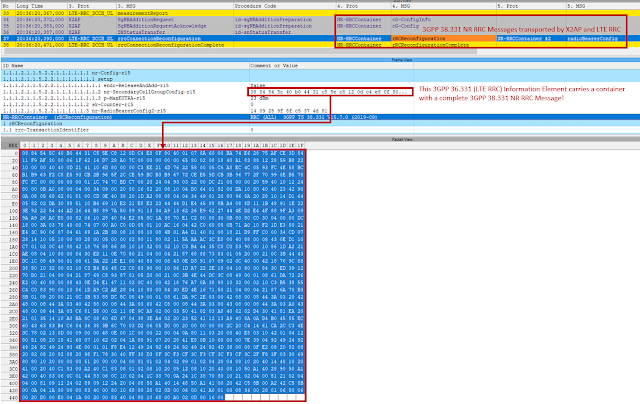
However, when looking into the details of e.g. the nr-SecondaryCellGroupConfig-r15 it turns out that some this single information element is indeed a huge block of NR information (total size: 1111 Byte)

It is an entire 5G RRC message (rRCReconfiguration) that is piggybacked by the LTE rrcConnectionReconfiguration message, because in 5G non-standalone mode this is the only way to transmit 5G signaling information to the UE. And as highlighted in the upper part of the screenshot there are a couple of NR RRC messages transported in so-called NR-RRCContainers* during the EN-DC Establishment Procedure.

And what about 5G standalone mode? For this radio access technology the 3GPP 38.331 Rel. 15 protocol is suitable as well. Hence, some parameters mentioned in the standard paper will never be seen in EN-DC. A perfect example is S-NSSAI (Single Network Slice Selection Assistance Information), because network slicing requires the connection with a 5G core network as a prerequisite. 

(click on image for larger version)

* This is not an 3GPP term, but coined by the developers of the decoding engine.

EN-DC SRB3 Demystified


3GPP 37.340 says that it is up the secondary node to establish "SRB3", but what exactly does this mean and how is it done?

Simple answer: The establishment of a signaling radio bearer (SRB) 3 in EN-DC mode means that RRC Measurement Reports for NR quality can be sent directly to the SgNB. This enables the 5G node to make intra-SgNB handover decisions and start the handover execution without involving the master eNodeB of the connection.

To prevent confusion the figure below shows a simplified scenario in which the Complete/Acknowledgement messages are not mentioned although they will be seen in the message flow.

A prerequisite is the successful addition of 5G radio resources as described in an earlier blog post. After this is completed the UE in the example transmits user plane information over the NR cell with the physical cell ID (PCI) = 12. In the transport network this cell is identified by NR CGI = xxxx52 (where „xxxx“ stands for a valid PLMN-ID and gNodeB-ID).

In the figure below the SgNB sends a X2AP SgNB Modification Required message that carries an embedded NR RRC cG-Config message. This cG-Config message is transparently forwarded by the MeNB to the UE. When arriving at the UE it activates CSI reference signal measurements on the 5G frequency including the serving 5G cell as well as its neighbors. It shall be noticed that here the concept of the Special Cell (SpCell) applies as it was defined for LTE-A CoMP scenarios. 

Instead of the X2AP SgNB Modification Required message the information for activating the CSI reference signal measurements can alternatively transported using the X2AP SgNB Addition Request Acknowledge or X2AP SgNB Change Required message.

In step 2 the UE sends a NR RRC (3GPP 38.331) Measurement Report that indicates a stronger 5G cell (the neighbor cell with PCI = 11) was measured. It might be a vendor-specific implementation to send this NR RRC Measurement Report simultaneously over uplink channels of the LTE radio link where it is carried by the LTE RRC Uplink Information Transfer MRDC (Multi-RAT Dual Connectivity) as well as over NR radio links where it is forwarded by the SgNB to the MeNB embedded in a X2AP RRC Transfer message.

Indeed, it is the SgNB that makes the handover decision, but since the MeNB is in charge of the signaling connection the handover command (here: another NR RRC cG-Config message that orders to switch the 5G radio link to the cell with PCI = 11) must be transmitted to the MeNB by using another X2AP SgNB Modification Required message.

After the UE received the NR CC cG-Config message sent by the SgNB the HO is executed and the 5G cell with PCI = 11 becomes the new primary secondary cell of the EN-DC connection.


Figure: Measurement Configuration, Reporting and Execution for intra-SgNB  Handover 

5G Call Drops in EN-DC: A Thread for Service Quality?


As explained in the post about EN-DC setup the addition of 5G NR radio resources to an ongoing LTE connection provides additional bandwidth for user plane data transmission. And it seems to be fair to say that at least in social media today 5G speed test results, especially throughput measurements, are treated as the benchmark for EN-DC service performance. Hence, it is also logical that a loss of the physical 5G radio link (5G drop) could have a serious impact on user experience.

I write "could", because as a matter of fact many 5G drops will not be recognized by subscribers using non-realtime services including HTTP streaming.

Due to the dual connectivity of LTE Master eNodeB (MeNB) and Secondary gNodeB (SgNB) the signaling trigger points indicating a 5G drop are also a bit more complex compared to what we know from LTE. Indeed, both network nodes are able to release 5G radio resources abnormally using three different X2AP message flow scenarios as shown in figure 1.

Figure 1: Three Basic Signaling Flows for Abnormal Release of 5G Radio Resources

Which of these individual message flows will be found in the trace data depends on which of the two base stations is the first one that detects a problem on the 5G radio link.

A particular case that is seen quite often in live networks is illustrated in figure 2.

Figure 2: 5G Drop due to SGC Failure in UE


Here the trigger is a LTE RRC SCG Failure Information NR message sent by the UE to the MeNB. Thus, the MeNB requests the release of 5G radio resources, which is acknowledged and executed by the SgNB.

In addition (not show in the figures) also the GTP/IP-Tunnel for user plane transport between S-GW and gNB is released by the MeNB after successful completion of the X2AP SgNB Release procedure.

For the UE the 5G drop is not as serious as a drop of the LTE radio connection would be. It is just a fallback on plain LTE, so to say. And after the switching the GTP/IP-Tunnel back to a downlink endpoint at the eNB 4G payload transmission continues.

The longer the overall duration of the radio connection the higher is the risk that the 5G radio resources are lost during an EN-DC call. One of my favorite cases is a subscriber with a radio connection that last a bit more than two and a half hours - see figure 3.

Figure 3: Location Session Record of a Single Subscriber indicating a total number 340 SgNB Drops over 2:33 Hours

Thanks to the smart algorithms of NETSCOUT's TrueCall geolocation engine there is high confidence that she or he sits in an indoor environment, but is served by an outdoor 5G cell. Thus, the penetration loss of the 5G signal is significant. Due to the higher frequency the path loss has also higher impact on the 5G than on the 4G radio signal. This seems to be the main reason why the 5G radio link drops as often as 340 times, which leads to an overall 5G (SgNB) Drop Rate of 83% for this connection.

However, the impact on the subscriber experience might not be a serious one as a different KPI, the 5G EN-DC Duration Rate indicates. According to the Duration Rate 99.99% of all the time 5G radio resources have been available for the subscriber. This is possible, because as also shown in figure 2 within a relatively short time new 5G radio resources are allocated again to this connection. Even if the subscriber is watching e.g. a Netflix video the buffering of already downloaded data on the end user device should be sufficient to conceal the short interruption of the data transfer over 5G resources.

With rising amount of EN-DC traffic it might be rather problematic for the network to handle the additional signaling load originating from the frequent 5G additions and releases. In extreme cases this may even lead to congestion due to CPU overload in RAN nodes or virtual network functions.

For realtime services like Voice over New Radio (VoNR) the entire situation changes. Here even short interruptions of the user plane radio transmission can be perceived by subscribers so that the above discussed 5G Duration Rate KPI will become insufficient to estimate the service quality. Hence, this will drive the demand for a fully integrated view of 5G RAN and Core KPIs covering both, signaling and application quality.