Pages

Subscribe:

Facebook decides to interfere with your time zone too!

The experts at Facebook have releases a time-keeping service titled the time.facebook.com. According to reports, the timekeeping software will work in a similar manner as time.google.com and time.apple.com.

Of course, there will be some modifications!

According to Facebook, inaccuracy in timekeeping can lead to a number of missed appointments and delays. However, their new public time-keeping service relies on a combination of satellite data and their own service to minimize any imprecision in time.

Facebook also highlights that in everyday circumstances like setting the oven timer – a minute difference won’t matter much. But it is an important consideration for other services that are dependent on making transactions in different data centers at the same time.

Facebook further explained that internet services are synced via a Network Time Protocol (NTP). Even our computers and mobile phones are coordinated with the NTP that syncs our clocks to UCT or Universal Coordinated Time.

But after a thorough investigation, Facebook concludes that there is some inaccuracy with the NTP. It is popular but not precise.

In order to rectify the time difference between their data servers, Facebook went ahead to make their own. According to the company, the same method is offered by Google and Apple as well. However, in the comparison - time.facebook.com is more precise by microseconds, instead of milliseconds.

The team acknowledges that it is not something life-changing but it certainly is helpful for processes that are time-stamped and any discrepancy in time could lead to potential problems.

You can also try out the new service by Facebook and coordinate your system’s time with the social media network by visiting time.facebook.com.


Read next: Quiet Model and Schedule Quiet Mode - Facebook's new features on the way

WHO to the Rescue: WhatsApp Goes Extra Miles to Help People Overcome Fears of Coronavirus

World Health Organization (WHO) is coming up with all possible ways to provide information regarding coronavirus.

Social media platforms including Facebook and WhatsApp are try their best to spread the facts and curb the misinformation.

The struggle of distributing “authentic” content in timely manner is a real struggle, in the past WhatsApp has faced a lot of criticism for facilitating fake news.

The coronavirus that initially originated from Wuhan, China is now stated as a Global pandemic by WHO. With its horrendous outbreak, it has affected millions of people and has claimed many lives already...and it’s still spreading! Almost every country is taking quarantine and social distancing measures to combat the disease.

In these times of global social distress, people are staying at home all the time, with restaurants, bars, malls, and other recreational activities at a halt. This has prompted the extensive use of smartphones and mobile applications, social media sites taking the lead amongst them all. Facebook, Instagram, and WhatsApp have become the major sources of communication. Recently, Facebook, YouTube, and other applications took measures to stop spreading false news, and now WhatsApp is taking responsible measures in collaboration with the World Health Organization.

On Friday, WHO launched a chat bot for WhatsApp messenger app where it provides details, precautionary measures and other authentic information regarding coronavirus. All user around the world who have Whatsapp installed on their devices can simply start conversation with bot by simply adding this number in contacts +41798931892 and sending a simple hi. This is an effective, easy and safe way to gain information and clear all the misconceptions and myths regarding this pandemic, and the virus itself!


This feature will also provide answers to frequently asked questions about this virus. The Facebook-owned messaging app has launched a Coronavirus Information Center to help you stay up to date with the latest official health information.

It is one of the best steps taken by these social media infotainment sites to help share reliable information and bust the myths and all falsified claims regarding the vicious COVID-19, the disease caused by the coronavirus. People need to become more responsible in sharing news too because it is very easy to spread misinformation and propaganda nowadays through these media. This global pandemic is not a joke, as it has now infected more than 265,000 people and killed more than 11,000 globally.

Be vigilant and stay safe everyone! That is the need of the hour.

Here's how to get the right facts from WHO right in your Whatsapp messenger app

Read next: Google launches website and tools dedicated to COVID-19

Google and YouTube Introduces New Resource Pages to Help Teachers and Families to Educate Students At Home

As the Coronavirus has taken over almost all over the world, the countries are shutting down. Some people are going into self-isolation while others are put into quarantine by the government and health officials. Schools, offices, universities, market places, cinemas, and other public gathering venues are being shut down to fight the highly contagious virus of Corona. Amidst this time of fear and panic; YouTube and Google have launched new resource pages which will help families in isolation and quarantine to teach their kids at home while their schools and other educational institutes remain closed.

The pages are going to effectively help teachers and students in the process of learning and educating during the crisis. The page of Google is called ‘Teach from Home’ and it offers many recommendations on how teachers can teach while staying at home with the help of Google products. The pages are simple and clean, currently, there are suggestions including how teachers can do a group video call with Google Hangouts or how online quizzes can be made by using Google Forms.


Apart from this, the ‘Teach from Home’ also has a ‘Teach from Home Toolkit’ which can help the users to personalize their experience on these pages as well as to help the users to organize their stuff into slides. The pages of ‘Teach from Home’ are currently available only in the English language. However, its toolkit is available in other ten languages including Arabic, German, Danish, French, Spanish, Polish and Italian. Google announced that more languages will be a part of this toolkit soon. Apart from all this, Google is also launching a Distance Learning Fund (DLF) which is formed in response to COVID-19. The money generated from this fund will be given to the education partners of Google so that they provide good learning opportunities to the kids during this Corona Virus pandemic.


Like Google, YouTube also has a resource which is called ‘Learn@Home’. It highlights the educational channels on YouTube which students can watch at home on the recommendation of their teachers. This page has categories for all age groups of children and adults. YouTube will be partnering with a lot of educational institutes including the Khan Academy for their resource page.


The service of ‘Learn@Home’ is also available currently in English but will soon be available in Korean, French, Japanese, French, Chinese, etc. the channels that are currently mentioned on the resource pages are Discovery Education, Crash Courses, PBS Kids, Cool School, and Sesame Street. But soon more channels will be highlighted too.

Read next: Google launches website and tools dedicated to COVID-19

Google launches website and tools dedicated to COVID-19

The outbreak of coronavirus has created a panic situation all over the globe. While citizens are strictly advised to stay home by government officials, health authorities are crumbling under the weight of growing diagnoses.

In these crucial times, various organizations are lending a helping hand in their community by rationing groceries, providing educational and entertainment materials, donating blood and simply reaching out with emotional support.

Tech companies including Facebook, Google, Microsoft, and Twitter are also doing their part during the pandemic and preventing misinformation from spreading on their platforms through different protocols. They are also highlighting relevant information regarding the illness to keep the visitors updated.

And now Google has introduced a dedicated website that would include comprehensive information about the coronavirus.

Coronavirus is a type of respiratory illness that was first ‘identified’ in the Wuhan district of China, in December 2019. Since then, the contagious disease has spread like wildfire with over 284,000 diagnoses and 11,000 + deaths globally.

To help the users, reach medical safety in a timely manner, Google has launched its ‘Information and Resource Website.’ Apart from general information such as symptoms, prevention, and statistics regarding the disease, the website will include directions to the health departments and access to test results.

The page also includes a ‘resources’ page with the help of YouTube which will consist of videos on various topics such as stay at home tips, family activities, meditation guide, recipes, and indoor exercises.


Google also plans to add more information as they become available. In their statement, the search giant said that coronavirus is the most searched topic globally and the company wants to ensure that the worldwide population stays updated with the correct information.

COVID-19 Google Trends

Alongside the website, Google has added a COVID-19 warning message to all medical-related queries on Maps. The message is brief but directs the individuals to call their doctor before visiting the specific COVID-19 office if they suspect of being infected with the coronavirus.

Read next: Facebook suggests its users to take social distancing measures responsibly

Facebook suggests its users to take social distancing measures responsibly

Because of amid rise in the cases of COVID-19, the Facebook has announced to provide information about coronavirus to its users in USA and Europe that would come in their news feed by setting up coronavirus information center to encourage them to distance themselves socially. The CEO, Mark Zuckerberg said that the main aim to start the service is to ask people to take social distancing seriously.

The information will be provided 24 hours long to around the world by collaborating with known authorities of the world. The CEO said that information center has been set up by collaborating with World Health Organization (WHO) and General Dental Council (GDC). Besides, it was announced by Zuckerberg that the software, communication enterprise and workplace will be provided to the government and emergency center for free for 12 months.

Mr. Zuckerberg further said that the use of Facebook and voice messages of WhatsApp has been increased a lot during coronavirus pandemic and the company is trying to use its infrastructure to support public health and people.

The pandemic coronavirus has brought massive destruction in shares and stock market. The shares of social media plunged more than 33 percent in 2020. Earlier in March, the company stop taking ads and the end of last month- 27th February, the company cancelled F8 Annual Software Developers Conference.

Recently, Facebook asked its workers to work for the social media and company from home. Besides, it is announced to give bonus of $1000 to its 45,000 employees who work as full-time. Moreover, the company will begin $100 million program to assist struggling businesses who suffered because of the pandemic.

Currently, more than 277,000 people are suffering from COVID-19, and 91,981 have been recovered, while more than 11,400 are died because of it, as Worldometers reported.


Read next: Google’s New Doodle Honors Ignaz Semmelweis, the Father of Infection Control

Instagram Aims to Reach New Heights, Tests Adding Location And Hashtags in Story Highlights

  • Instagram plans to add Location and Hashtags to Your Story Highlights now.
  • Instagram was first released in 2010, and since then, it has seen many modifications and improvements. Throughout its journey of gradual betterment, the importance of Instagram Hashtags remained consistent.
  • It is common knowledge that hashtags are used to make your content discoverable. The perfect hashtag can put a post in front of the right audience, whether they previously followed you or not!

Instagram Stories are nothing new, as they have been used by many people, even though these stories disappear in 24 hours. To make them more fun and increase the visibility of the profile, Instagram later added a feature called, “Instagram Highlights.”

Instagram Highlights are groups of stories that can be created as folder sections on your Instagram profiles. Once a story is posted, it can be saved in a Highlight, like a folder, that will be displayed on your Instagram profile.

There is an option to archive the stories and in the future create highlights from the saved stories in the archive too.

Now the question arises that why these Instagram Highlights are so Important?

The thing is that the Instagram Stories have become a major portal for varied brands to connect, engage and gain tangible results from their digital marketing ventures. Instagram stories used for business can surge your competitive advantages to newer heights!

So using the Highlights can further enhance your purpose as they let you use this format to tell an ongoing story, make your stories reachable to new followers, promote your previous activities posted in the stories, showcase your services or products in a categorized manner, and provide a library format of all the useful content that you have already shared.


Now think about Instagram letting you add location and hashtags to your Story Highlights – Just imagine the effect it will have on your overall content because the importance of Instagram Hashtags cannot be disregarded. These hashtags are one of the most effective ways to engage more audience on your Instagram posts. Statistically speaking, a post with at least one Instagram hashtag averages 12.6 percent more engagement than posts without a hashtag. So, there is no denying the worth of using proper hashtags for your posts in a strategic manner, so that you can get more followers, improve your posts’ engagement rates, and build a community around your business with proper marketing.

The use of relevant, targeted hashtags on your posts and stories is still one of the best ways to get discovered by new audiences on Instagram already, and a recent development, as spotted by Jane Manchun Wong, is making rounds that the Facebook-owned app is planning to allow Location and up to four Hashtags to your Story Highlights now will up your game to the next level!

Imagine, how amazing it will be!

This can make more engagement possible, with more followers, and more clientele for your business.

The date of launch for this valued feature has not been announced yet but keeping the record of Instagram's constant efforts towards advancement in mind, this feature will likely be added very soon.

Excited, aren’t you?


Read next: Just In: Instagram Protypes Dual Camera

Real-life 5G Use Cases for Verticals from China

GSMA have recently published a series of reports related to China. This includes the 'The Mobile Economy China' report as well as reports on ‘Impacts of mmWave 5G in China’, ‘5G use cases for verticals China 2020’ and ‘Powered by SA case studies’. They are all available here.

China currently has 1.65bn subscribers (Excluding licensed cellular IoT) which is expected to grow to 1.73bn in 2025. The report quotes 1.20bn unique mobile subscribers that is expected to grow to 1.26bn by 2025. With a population of 1.44 billion, this would be assuming everyone over 10 years has a smartphone. 2G and 3G is being phased out so only 4G and 5G will be around in 2025. This would be different for IoT.

The 5G Use Cases for Verticals China 2020 report is comprised of 15 outstanding examples of 5G-empowered applications for verticals, ranging from industrial manufacturing, transportation, electric power, healthcare, education, to content creation, and zooms into the practical scenarios, technical features, and development opportunities for the next generation technology. Every use case represents the relentless efforts of 5G pioneers who are open, cooperative, and innovative.

  1. Flexible Smart Manufacturing with 5G Edge Computing (RoboTechnik, China Mobile, Ericsson)
  2. 5G Smart Campus in Haier Tianjin Washing Machine Factory (China Mobile, Haier)
  3. Aircraft Surface Inspection with 5G and 8K at Commercial Aircraft Corporation of China (Comac, China Unicom, Huawei)
  4. Xinfengming Group’s Smart Factory Based on MEC Technology (Xinfengming, China Mobile, ZTE)
  5. SANY Heavy Industry 5G and Smart Manufacturing (Sany, China Mobile, China Telecom, ZTE)
  6. Xiangtan Iron & Steel's 5G Smart Plant (Xisc, China Mobile, Huawei)
  7. The Tianjin 5G Smart Port (Tianjin, China Unicom, ZTE, Trunk)
  8. 5G Intelligent Connected Vehicle Pilot in Wuhan (China Mobile, Huawei, et al.)
  9. 5G BRT Connected Vehicle-Infrastructure Cooperative System (China Unicom, DTmobile, et al.)
  10. 5G for Smart Grid (China Mobile, Huawei, et al.)
  11. Migu's "Quick Gaming" Platform (China Mobile, et al.)
  12. 5G Cloud VR Demonstration Zone in Honggutan, Nanchang, Jiangxi Province (Besttone, China Telecom, Huawei)
  13. 5G Cloud VR Education Application Based on AI QoE (China Telecom, Nokia, et al.)
  14. China MOOC Conference: 5G + Remote Virtual Simulation Experiment (China Unicom, Vive HTC, Dell Technologies, et al.)
  15. 5G-empowered Hospital Network Architecture Standard (CAICT, China Mobile, China Telecom, China Unicom, Huawei, et al.)

They are all detailed in the report here.

I have written about 5G Use Cases in a blog post earlier, which also contains a video playlist of use cases from around the world. Not many from China in there at the moment but should be added as and when they are available and I discover them.


Related Posts:

How Cellular IoT and AI Can Help to Overcome Extreme Poverty in a Climate-resilient Way

The Democratic Republic ofthe Congo (DRC) is the second largest country in Africa and it has a significant potential for agricultural development as the country has more land (235 million hectares) than Kenya, Malawi, Tanzania, and Zambia, combined, of which only 3.4% is cultivated.

Despite this, around 13 millions of Congolese live in extreme food insecurity, among them 5 millions acutely malnourished children. Current assessments show the trend is increasing.

In the southern provinces formerly known as "Katanga" the needs in maize for human consumption sum up to 700,000 tons per year, while the local production barely amounts to 120,000 tons per year. This means the provinces have to resort to importing food from neighboring countries, which represents a huge burden on the region's economy.

Another aspect of the problem is that 80% of the local production is made by women farmers, and the biggest challenge they face is the lack of daily agronomic monitoring and guidance. There is only a limited amount of agriculture experts in the region and without assistance, the farmersaverage output is at best one ton per hectare. However, field trials have proven that by using smart farming technology they can easily produce up to 6 tons per hectare year over year with the right sustainable approach and support. Artificial intelligence (AI), the Internet of Things (IoT) and big data analytics underpinned by mobile connectivity can even do more. They bring significant potential for capturing carbon, optimizing water, pesticide and fertilizer usage, and reducing soil erosion. Thus, African women can not only provide the solution to the local food gap/insecurity but also become the primary protectors of their environment.

The basic technical concept is not new. Back in 2016 Ooredoo Myanmar launched Site Pyo, a mobile agriculture information service for smallholder farmers. At its core Site Pyo is a weather forecast app that was enhanced with weather-dependent advice for ten crops, from seed selection to harvesting and storage. In addition the app displays the actual market prices for these crops. GSMA as a co-funder of the project celebrates Site Pyo as a big success, but it seems to be limited to Myanmar. Why?

„A lot of customization needs to be done to adapt the application functionality for a particular region“, says Dieu-Donné Okalas Ossami, CEO of „e-tumba“, a French Start-up specialized in smart farming solutions for Sub-Sahara Africa. His company partners with iTK, a spin-off from CIRAD, the French Institute for tropical agronomy. The iTK crop-specific predictive models are based on years of agronomic data, but have originally been designed for big farmers. To meet the demands of women in Katanga requires more granular data for both, input and output.

As in case of Site Pyo weather predictions are important, but in addition there are data feeds from sensors on the spot. Weather stations measure constantly temperature and rainfall while sensors in the soil report its saturation with water, nitrogen and potassium.

„A typical real-time advice that our software provides is to delay the harvest for some additional days to maximize the yield“, explains Okalas Ossami. „However, even for two neighboring fields the particular advices are often different.“ 

Also the communication channels need to be taylored. Many women farmers are illiterate. For them the advice must be translated into the local language they speak and transmitted to their phones as a voice message. Those who can read and write will receive the notifications through short message service.

The mobile connectivity that links all elements of the system is realized by the mobile network operators present in the region.


Infographic: The Technical Environment Behind the Project
„Actually NB-IoT would fit to our use case“, says Okalas Ossami, „but it is not available. And there is neither LoRa nor SigFox.“ Hence, the sensors are using data connections of 3G and 4G radio access technology. In case of network outage or missing coverage a local field technician must collect the sensor data manually and transfer it to the data center through alternative channels.

It is the same field technician who installs the sensors. The woman farmers receive a basic training to understand how the system works, but they do not need to care about technical components - except keeping their mobile phones charged.

Here comes another important aspect into the game: How can the women trust this technical environment?

In case of Site Pyo the operator Ooredoo observed a quickly increasing user community measured by the number of app downloads. However, there was no indication to which extend the Myanmar farmers really used the app. The e-tumba solution addresses this gap by partnering with the non-government organization „Anzafrika“.

Anzafrika is present in the villages where the people live. One of its major targets is to overcome the extreme poverty by developing the regional economy. A key factor for this is that the smallholder farmers do not just see the market prices for their crops, but get real access to large, stable and long-term markets where these prices are paid. Anzafrika is brokering contracts between the woman farmers and large multinational corporations committed to the Economics of Mutuality, growing human, social and natural capital. The business model behind this concept was outlined by Bruno Roche and Jay Jakub in their book „Completing Capitalism:Heal Business to Heal the World“. Instead of focusing on greenhouse gas emissions (output) they insist that climate-resilient business models must measure the input needed for manufacturing goods. As an example: For one hot cup of coffee the greenhouse gas emissions are extremely low, but 3.4 liters of water are needed (most for packaging, processing and drinking) and 12 gram of top soil will be eroded. These are (among others) the expenses paid by the planet that are not taken into account by a carbon tax.

Coffee plantations are monocultures with all the known disadvantages resulting form this kind of farming. In the past the Congolese women farmers have grown maize as a monoculture. Now, with advice from Anzafrika and e-tumba they transitioned from an „all-maize“ sustenance crop to a semi-industrial „maize-sorghum“ production. This helps to minimize the top soil erosion and thus, to remunerate the natural capital involved in the process.  

Regarding the human and social capital Anzafrika monitors how the overall situation in the villages  is improving. The focus is on progress in well-beeing, satisfaction and health not just for the women farmers, but for their entire communities.

In 2019 smart farming technology have been tested and deployed with a group of 150 women in the province of Lualaba. Now, in 2020, their number is expected to rise to 500 and after 6 years the stunning target of 100,000 participants shall be met. A look at the download numbers of Site Pyo (206,000 in the course of one year) shows that these numbers are not over-optimistic.

The partnership between Anzafrika, e-tumba and iTK is now considered as a best international practice, as indicated by Patrick Gilabert, UNIDO Representative to the European Union in Brussels. It fully aligns with the development of new comprehensive strategies for Africa that aim at creating a partnership of equals and mutual interest through agriculture, trade and investment partnerships.

UNIDO, as the UN convener for the implementation of the Industrial Decade for Development of Africa” (IDDA 3) is always ready to join forces with innovative partners.

How LTE RRC (4G) and NR RRC (5G) Protocols are used in Parallel in EN-DC (5G NSA)

Last week I had a fruitful discussion with a fellow blogger on the web, Martin Sauter (@mobilesociety) regarding a post in which he compared features of LTE RRC (3GPP 36.331) and NR RRC (3GPP 38.331).

It was Martin's impression that the NR RRC protocol is primarily designed to be used in the 5G standalone mode. However, as I wrote in a comment to his post the NR RRC protocol is already used in EN-DC radio connections.

The reason is that the UE must be informed about Hundreds of lower layer 5G parameters (physical, MAC, RLC) that are needed for the payload transmission over 5G frequencies. Indeed, when it comes to user plane data transmission the gNB works almost independently and the UE must handle LTE and NR radio links in parallel.So it has two different radio units (even if combined into a single radio chip set). This double-functionality is also one important reason why 5G smartphones are quite expensive. It is a lot of software and know-how that sits inside these chips.

How much surplus code is really necessary to enable 5G technology becomes visible when looking at trace data using a state-of-the-art protocol test and monitoring tool.

When reading the 3GPP 36.331 (LTE RRC) standard document one might have the impression that just a few 5G parameters have been incorporated into this protocol to support EN-DC connections.

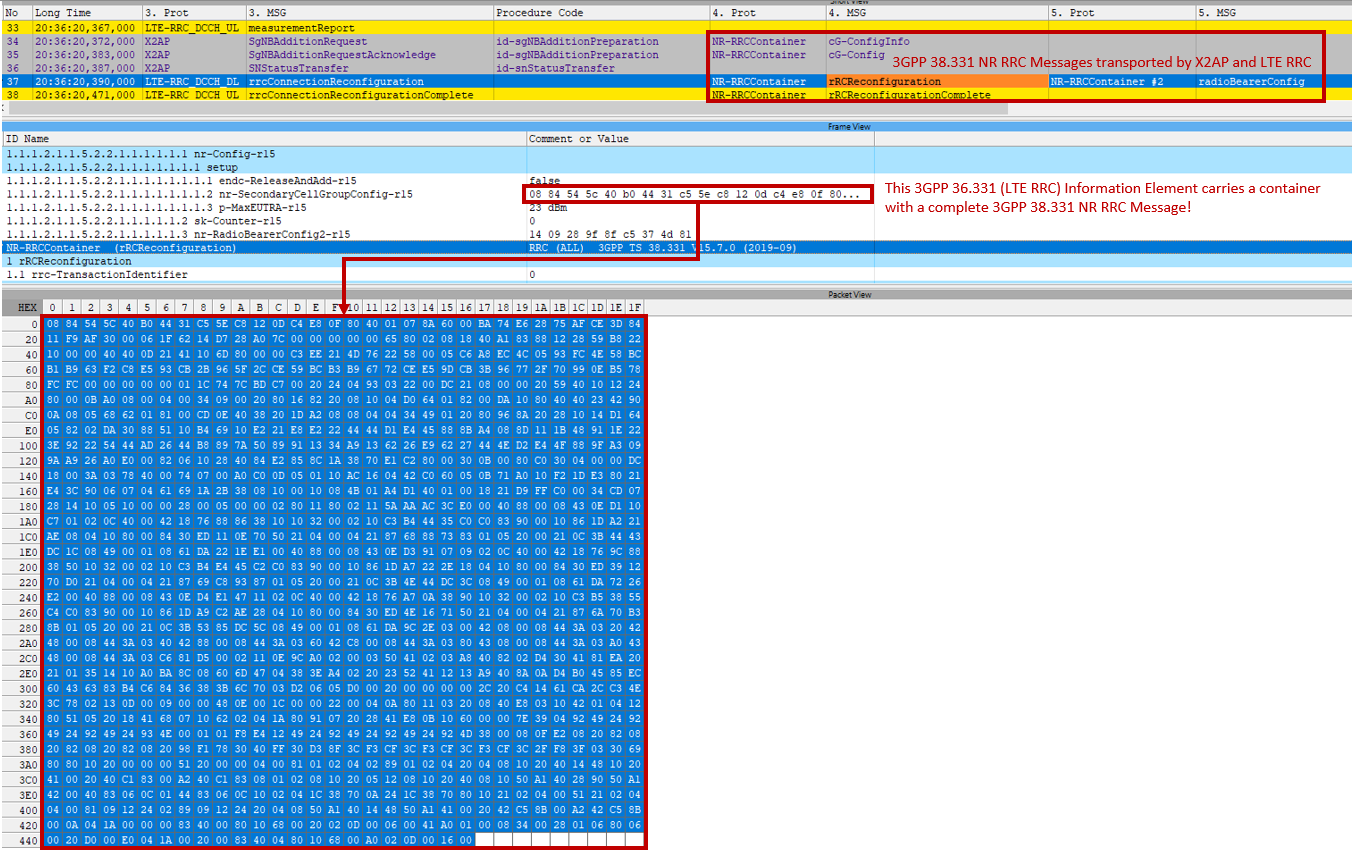
However, when looking into the details of e.g. the nr-SecondaryCellGroupConfig-r15 it turns out that some this single information element is indeed a huge block of NR information (total size: 1111 Byte)

It is an entire 5G RRC message (rRCReconfiguration) that is piggybacked by the LTE rrcConnectionReconfiguration message, because in 5G non-standalone mode this is the only way to transmit 5G signaling information to the UE. And as highlighted in the upper part of the screenshot there are a couple of NR RRC messages transported in so-called NR-RRCContainers* during the EN-DC Establishment Procedure.

And what about 5G standalone mode? For this radio access technology the 3GPP 38.331 Rel. 15 protocol is suitable as well. Hence, some parameters mentioned in the standard paper will never be seen in EN-DC. A perfect example is S-NSSAI (Single Network Slice Selection Assistance Information), because network slicing requires the connection with a 5G core network as a prerequisite. 


(click on image for larger version)

* This is not an 3GPP term, but coined by the developers of the decoding engine.

A Look into 5G Virtual/Open RAN - Part 1

Although it is understood in general that virtualization and increasing complexity are inherent characteristics of 5G networks many people are surprised when they realize the significant differences of 5G RAN architecture and signaling procedures compared to what they know from LTE or UTRAN.

In this blog post series I want to highlight some details that are not immediately visible when reading the 3GPP specs.

Figure 1 shows a virtualized gNB and the protocols it uses to communicate with its internal entities as well as with the UE and peer entities in neighbor network elements/functions.

Figure 1: Virtual Network Functions and Protocols in 5G RAN
(click on the image to see full size)

The core of the whole thing is the gNB-Central Unit for the Control Plane (gNB-CU CP). This function communicates directly with the UE using the NR RRC protocol. It also "talks" to the 5G Core Network represented by the AMF using the NGAP, a protocol very similar to the S1AP known from E-UTRAN. Neighboring 5G base stations are contacted using the XnAP, neighboring eNBs can be reached by using X2AP.

The other virtual functions of the gNB are the Central Units for User Plane (gNB-CU UP) and the Distributed Units (gNB-DU). While the gNB-CU UP is responsible for handling the transport of payload the gNB-DUs deal with all the allocation of radio resources, especially the scheduling. As a result the lower layer radio interface protocols, especially RLC and MAC terminate in the gNB-DUs.

For the RAN monitoring tools and the 3GPP Minimization of Drive Test (MDT) feature this means that RRC and Logged Measurement Reports sent by UEs will be available at gN-CU CP while all uplink radio quality measurements and call-related user plane metrics is only available at the gNB-DU - see figure 3.

Figure 2: Distribution of un-correlated RAN measurement tasks among different gNB virtual functions
(click on the image to see full size) 

And today, there is no 3GPP-standardized procedure to correlate this measurement information collected by different virtual gNB functions.

The full impact of the 5G RAN virtualization becomes even more evident when looking at Figure 3. It shows a single gNB-CU CP in charge of controlling several gNB-CU UPs and gNB-DUs.

In a live network deployment a single gNB-CU CP will control hundreds of gNB-DUs and maybe several gNB-CU UPs. This is why it is misleading to compare the connectivity of a gNB-CU CP with that of a LTE eNB. Rather it could be compared with a UTRAN RNC controlling a similar number of 3G base stations.


Figure 3: 5G RAN Connectivity
(click on the image to see full size)

Looking back into figure 1 we see that the F1AP is used for communication between gNB-CU CP and its gNB-DUs while the E1AP is the protocol that connects the gNB-CU CP with surrounding gNB-CU UPs.

Call-related control plane procedures of F1AP and E1AP are very similar to what is known from NGAP. There is a UE context established between the gNB-CU CP and the gNB-DU. On F1-U a GTP tunnel is established for user plane transport. At the same time an E1 Bearer Context in gNB-CU CP and gNB-CU UP keeps track of the most relevant user plane transport parameters.

All in all for setting up a single subscriber connection in the virtualized 5G RAN there are significantly more signaling transactions necessary than in E-UTRAN. Figure 4 shows a practical example.

Figure 4: 5G RAN Call Trace in NETSCOUT Session Analyzer
(click on the image to see full size)
The volume and complexity of signaling information is increasing when the UE moves or is redirected to virtual functions within one gNB e.g. due to load balancing.

The next blog post of this series will dive deeper into details of such call scenarios.

Stay tuned...